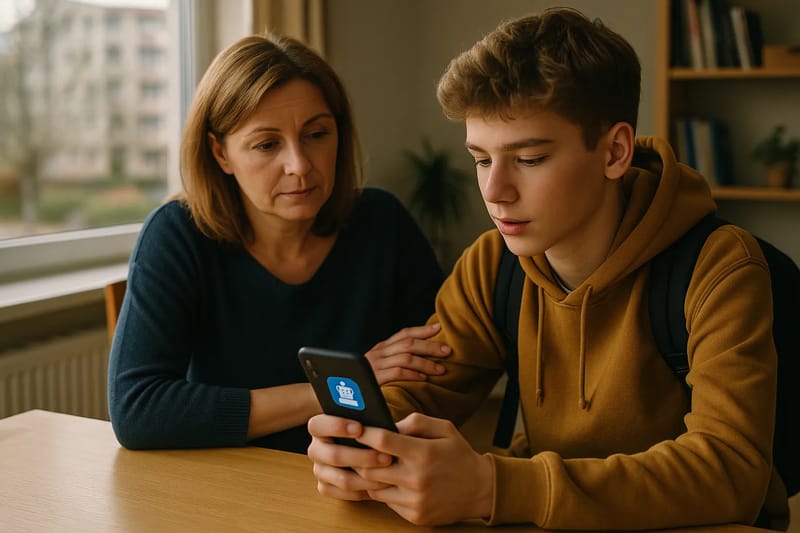
In the era of rapid development of artificial intelligence technology, more and more parents are asking themselves what possibilities are offered by platforms where their children interact with AI chatbots. They are particularly interested in how these technologies might assist in safeguarding young people and what is available in Poland. Although some functions are not yet available in our country, it is worth examining the steps global platforms are taking.
Meta is introducing the latest solutions in this area. As Meta announced and TechCrunch reported (16 July 2026), parents using Instagram Parental Supervision are notified if their teen clearly refers to hurting themselves in a conversation with the Meta AI chatbot. According to Meta, every chat flagged by its system is reviewed by a person before an alert is sent. The feature is live in the USA, UK, Australia and Canada and is to roll out globally by the end of the year – in July 2026 it was not yet available in Poland.
Another example is Instagram. According to Meta (June 2026), supervising parents are notified when their teen repeatedly tries to search for terms related to suicide or self-harm within a short period of time. This feature has been rolled out in the European Union, Brazil and India – so it also works in Poland, provided the parent has supervision switched on for the teen's account.

According to the "Internet dzieci 2026" report, in November 2025, 43% of Polish internet users aged 7–14 used ChatGPT (app or website) at least once, and 15% on an average day. Platform alerts only work within those platforms and only when a parent turns on supervision – they cannot replace a conversation about what your child uses a chatbot for and who they can tell when something worries them.
And MichalKids? To be honest: MichalKids does not filter websites, does not block purchases, does not read your child's conversations and does not detect content, so it does not know what your child talks about with a chatbot. It shows the parent things like the child's location and zones, and gives the child an SOS button – in line with the principle "Your child sees the same data as you". It supports everyday safety; it is not an answer to the challenges of AI chatbots.

Most importantly, your child should know that difficult thoughts can be shared with a person, not just a chatbot. In Poland children can call or write to the 116 111 helpline for children and young people – available every day, around the clock. Parents can talk to a counsellor on 800 100 100. If a child's life is in danger, call 112.
Sources
- Meta, "Alerting Parents if Teens Show Signs of Distress in Conversations With Meta AI", July 2026
- TechCrunch, "Meta now alerts parents if their teen discussed suicide or self-harm with its AI chatbot", 16 July 2026
- Meta, "Strengthening Teen Accounts with New Safety Updates on Instagram and Facebook", June 2026
- Polskie Badania Internetu, "Internet dzieci 2026" (in Polish) – monthly reach of ChatGPT in November 2025: 43% of children aged 7–14 (daily 15%; report PDF, p. 66, chart 16)
- 116 111; FDDS – 800 100 100 (in Polish)