
Cyberbullying — What to Do? A Practical Guide for Parents
From the perspective of a computer science educator with over 25 years of IT experience.
What Is Cyberbullying?
Cyberbullying is repeated, intentional actions aimed at harming another person through technology. It includes messages, social media posts, photos, videos — anything that can be used against a child in the digital world.
Unlike traditional bullying, cyberbullying:
- Doesn't end after school — follows the child 24/7, even at home
- Has an audience — a post can be seen by the entire school, city, country
- Is permanent — once published, content can circulate for years
- Can be anonymous — the perpetrator feels untouchable
The Scale of the Problem
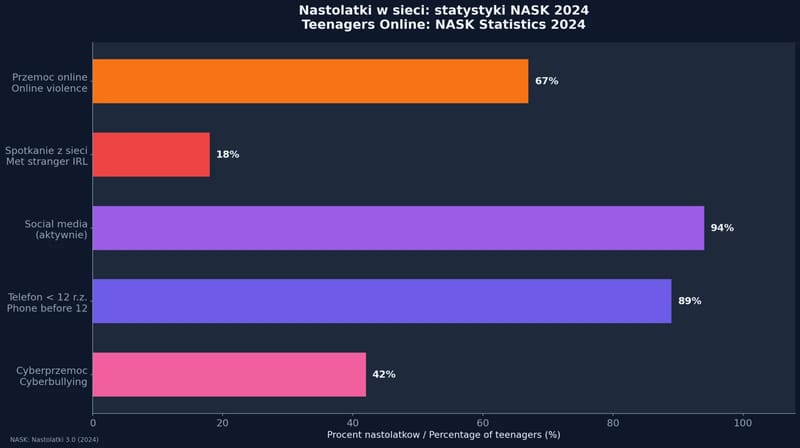
Research shows that 42% of Polish teenagers have experienced at least one form of cyberbullying. For girls aged 13-15, the rate reached 54%.
Most common forms:
- Offensive private messages (32%)
- Publicly humiliating posts (24%)
- Sharing photos without consent (18%)
- Creating fake profiles (12%)
- Excluding from online groups (28%)
Most concerning: 67% of victims didn't inform their parents. Main reason — "they were afraid the parent would take away their phone."
How to Recognize If Your Child Is a Victim?
Cyberbullying is rarely obvious. Your child won't come and say "someone is bullying me online." Instead, look for changes:
Behavioral:
- Suddenly avoids phone/computer — used to be glued to it, now puts it away
- Closes apps when you enter — hides the screen
- Withdraws from social life — stops going out, meeting friends
- Mood changes after phone use — crying, anger, silence
Physical signals:
- Sleep problems — insomnia, nightmares
- Headaches, stomachaches — psychosomatic stress symptoms
- Dropping grades — suddenly, without visible cause
- Changes in eating — loss or excessive appetite
What to Do Step by Step?
Step 1: Listen. Don't react impulsively.

DON'T say: "Why didn't you come sooner?" or "You should have just not replied."
DO say: "Thank you for telling me. This is not your fault. We'll solve this together."
A child who fears their parent's reaction won't come at all next time.
Step 2: Document everything.
- Screenshots — every message, comment, post. With dates and usernames
- Don't delete content — you may need it as evidence
- Save URLs — links to profiles, posts, groups
Step 3: Report on the platform.
Every major platform has a reporting mechanism:
- Instagram/TikTok: report post/comment + block user
- Discord: report server or user via Trust & Safety
- Snapchat: Support → report
Step 4: Notify the school.

Schools are now required to respond to cyberbullying even outside school grounds if it involves students. Contact:
- Class teacher — first step
- School counselor — when the teacher doesn't respond
- School administration — when the problem escalates
Step 5: Assess if it's a police matter.
If cyberbullying includes threats, nude photos, or stalking — report to the police. Laws protect children from cyberbullying, stalking, defamation, and distribution of intimate images of minors.
Step 6: Provide support.
- Children's helpline: 116 111 (free, 24/7)
- If the child needs it — a psychologist, not because "something is wrong," but because it's normal to need support
What NOT to Do?
- Don't take away the phone as punishment — the child will learn to hide problems
- Don't message the bully's parents on Facebook — adult escalation worsens the situation
- Don't say "just ignore it" — cyberbullying doesn't disappear from ignoring, and the child feels misunderstood
- Don't post about it publicly — it worsens the trauma
5 Prevention Rules for Families
- Build trust before there's a problem — regular conversations about online activity (without interrogation)
- Set rules together — a child who co-created the rules is more likely to follow them
- Teach to recognize dangerous patterns — "if someone writes something unpleasant more than once — it's not a joke"
- Show alternatives — blocking, reporting, talking to an adult. The child needs tools
- Be a role model — don't comment offensively online, don't ridicule others publicly
What We're Planning at MichalKids
Coming Soon
- AI Coach — weekly usage pattern reports (e.g., suddenly increased usage at midnight may signal a problem)
- Shared Goals — parent and child set screen goals together, building dialogue instead of control
- Academy: course "Cyberbullying — Recognize and React" teaches children to identify cyberbullying and respond
Guardian, not a spy. We don't read messages — we teach children to recognize threats independently.
Sources:
- NASK — Teenagers 3.0 (2024)
- Fundacja Dajemy Dzieciom Sile — cyberbullying
- Helpline.org.pl — online help